
Cutting 30-day readmissions nearly in half across an at-risk ACO population
.avif)
At a glance
46% fewer
30-day readmissions vs. same window prior year
pilot 30-day readmission rate (vs. 17.5% baseline)
5 weeks
from meeting to pilot start
~90%
reduction in care-coordination staff burden
Comparison basis:
The challenge
Manual outreach couldn’t keep up with a complex, at-risk population.
01
America’s MDE is a risk-bearing ACO. Avoidable 30-day readmissions are a direct quality and financial liability across its attributed population.
02
Post-discharge follow-up depended on manual staff outreach — limited reach and no consistent multi-touch cadence across the critical first three weeks.
03
A prior automated-outreach vendor had failed to engage patients, leaving leadership skeptical that AI could reliably reach a complex, largely senior population.
04
The population was primarily Medicare beneficiaries with multiple chronic conditions and elevated readmission risk.
05
At the clinic level, Medicare follow-up calls and scheduling competed with in-clinic demands, pulling staff away from the patients in front of them.
.avif)
The solution
Altira deployed Lena, its agentic voice and SMS engine, across Omni Healthcare for post-discharge transitions of care.
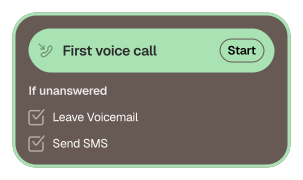
Real-time ADT feeds trigger outreach the same day a patient is discharged, reaching both patient and caregiver before the highest-risk first hours pass.
.svg)
Outbound engagement at Day 1, 7, 14, and 21 post-discharge, combining SMS and live voice calls.

Automated TCM appointment scheduling, confirmation, and follow-up completion, written back for the practice.

Clinical escalation to America’s MDE practices when a patient response warranted human attention.

Patients could opt out at any time; continuous, reconciled reporting was shared with the MDE quality team throughout.
No integration bottleneck
5 weeks
from first pilot conversation to live outreach. No lengthy integration project required to start.
The results
Same practice.
Same calendar window.
With and without Altira.
30-day readmissions fell from 17.5% to 9.6%, a nearly 8 percentage-point improvement in the rate of avoidable readmissions across the discharged population.


.png)
The results
Same practice.
Same calendar window.
With and without Altira.
76% transition-of-care completion across discharged patients, with 89% of scheduled PCP follow-up appointments attended and compliant.
.png)
The results
Same practice.
Same calendar window.
With and without Altira.
~90% reduction in care-coordination staff burden, freeing clinic teams to focus on the patients in front of them.
.png)
The results
Same practice.
Same calendar window.
With and without Altira.
Corroborated by a concurrent control. A non-pilot control practice ran an 11.5% readmission rate over the same pilot window, while Omni’s Altira-supported rate came in lower at 9.6%.
.png)
.avif)
estimated average cost of a Medicare readmission
The financial case
The pilot cut 30-day readmissions from 17.5% to 9.6%, against a concurrent control practice holding at 11.5%. Applied across the expanding population, the economics compound quickly.
01
Every 1 percentage-point reduction across a large Medicare population avoids millions in preventable cost — before recovered staff capacity and improved TCM revenue capture.
02
Returning ~90% of care-coordination staff time lets existing teams manage a far larger panel without added headcount — converting avoided cost into operating leverage.
03
On conservative assumptions, the program pays for itself many times over within the first year. Precise dollar impact scales with annualized discharge volume.
Proven at volume, built to expand
A program the customer chose to scale across its full book of business.
Launch
5 clinics

Pilot reach
7,500
Now rolling out
~30,000
This is not a proof of concept looking for a next step. It is a program the customer chose to scale across its full book of business
.svg)
.svg)
What our customers say
“Altira Health’s AI-powered outreach has helped our practices improve patient engagement by making it easier to connect with patients at the right time and keep them involved in their care.”


What our customers say
“We are extraordinarily impressed by Altira team. Their like mindedness and ability to understand the ACO goals and to deliver on the technology and then to pivot when there are challenges have fulfilled all of our expectations.”


What our customers say
“Since implementing Altira, we’ve eliminated significant operational overhead across our practices. The team loves working with them, and honestly, we couldn’t imagine running our operations without it now.”

.png)
Why it worked
.svg)
Real-time ADT feeds that trigger same-day outreach to patients and caregivers, the moment discharge risk is highest.

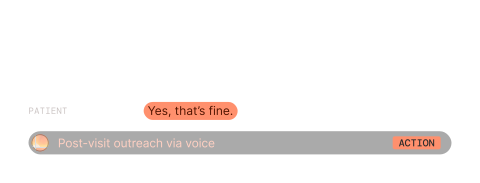
Full orchestration of SMS and voice, sequenced methodically so each channel reinforces the other across the post-discharge window.
Longitudinal clinical and behavioral memory, so each context-aware call at Day 7, Day 14, and Day 21 builds on what came before rather than starting cold.
Proprietary background-noise suppression that keeps voice conversations clear and usable in real-world home environments.
Clinically guided symptom tracking and risk monitoring on every touch, with escalation to the practice when a response warrants it.
Outcomes validated by the customer's own quality function, not just by Altira's reporting.
A forward-deployed model that started delivering value in weeks, not after a multi-month integration.
